20Nasser Hospital, again: a strike on the surgical building during the ceasefire
- Six killed, including a surgeon and a 13-year-old, says Gaza's health ministry; the army names one target, a Hamas brigade commander, and no civilian toll.
- The army says it warned “on several occasions”; the hospital director says no warning came. Neither claim can be checked independently — Israel keeps foreign press out of Gaza.
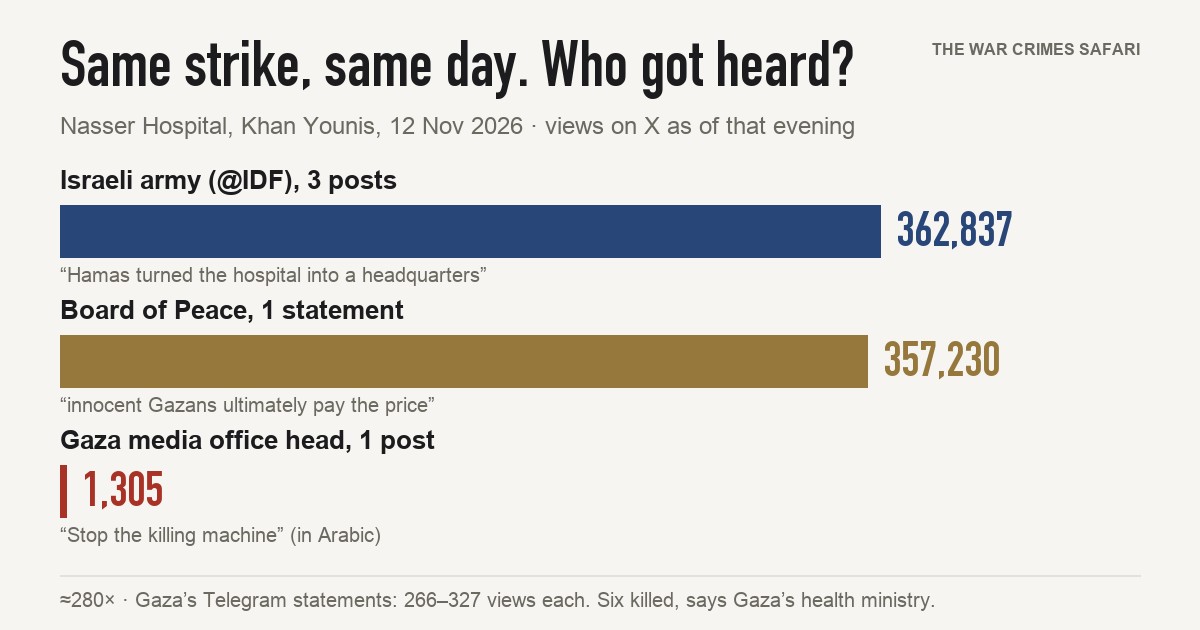
- The army's three posts: about 363,000 views. The Gaza media office head's post: 1,305. Roughly 280 to one.
Shortly after midnight on 12 November 2026, an Israeli strike hit the al-Yasin surgical building of Nasser Medical Complex in Khan Younis, the largest hospital in southern Gaza. Gaza's Hamas-run health ministry says six people were killed — medical staff, patients and companions, among them surgeon Dr Rizq Abu Shaira and a 13-year-old boy — and about 30 injured. The Israeli army says it struck Mohammed Abu Ismail, commander of Hamas's Khan Younis Brigade, and other fighters using the hospital's second floor as a headquarters, after repeated warnings; the hospital's director says no warning was received, and Hamas denies any military use. The army's three posts drew about 363,000 views on X that day; the Gaza media office head's, about 1,300.
Same strike, same day. Who got heard?
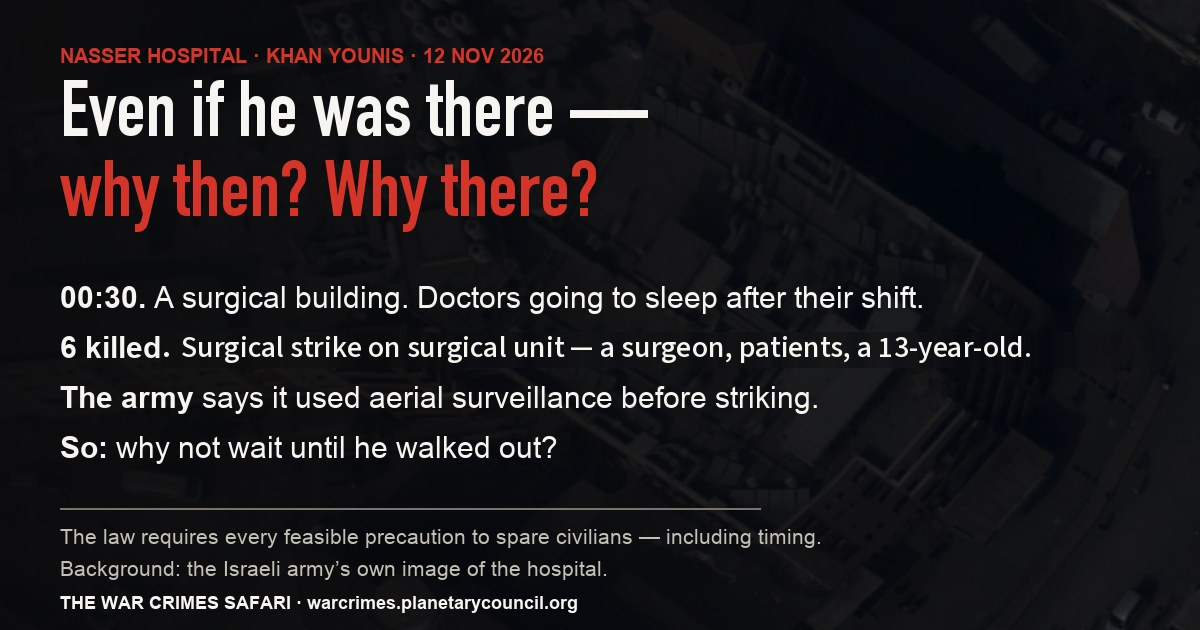
The army’s Hebrew statement, in X’s English translation
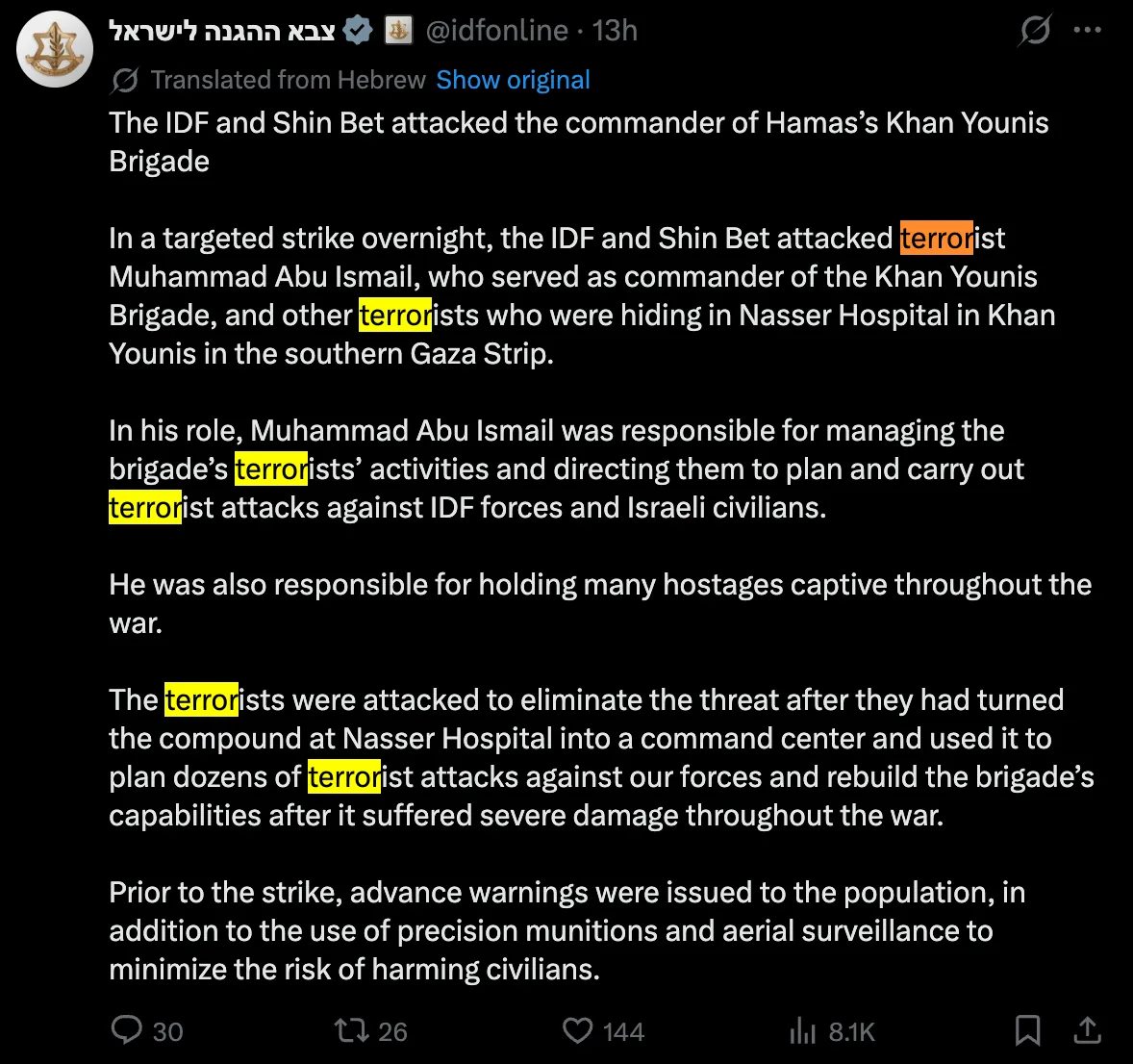
For sharing: why then? Why there?
Who says what
| Question | Israeli army | Gaza authorities (Hamas-run) & hospital | Independent |
|---|---|---|---|
| Who was killed? | “A senior Hamas terrorist and additional terrorists”; later named Mohammed Abu Ismail, Khan Younis Brigade commander. No civilian toll given | Six: medical staff, patients and companions, among them surgeon Dr Rizq Abu Shaira and Jihad Abu Tilkh, 13 | BBC spoke to a surgeon wounded in the head, Dr Mohammed Qdeih, who was lying near Dr Abu Shaira. The hospital, Civil Defence, WHO and MSF also confirmed the deaths, not only the health ministry (AP, MSF, WHO). PCHR published names and ages of all six. reported |
| Injured | — | About 30 (health ministry, via BBC); “more than 25” (media office) | MSF reported 52 injured; other counts range from about 20 to “more than 25.” reported |
| What was hit? | “The room from which the brigade commander & the other terrorist were conducting military activities” | The al-Yasin surgical building: surgical wards and intensive care; two missiles, one unexploded | BBC's freelance footage: operating theatre, wards and a medics' sleeping area damaged; agencies photographed what appears to be an unexploded missile reported |
| Warning? | Warned “on several occasions” that military activity at the hospital stop; released audio of what it says was a warning to a senior Gaza health official | Hospital director Dr Ahmed al-Fara: no warning was received | Not verifiable open |
| Military use? | Second floor a Hamas HQ closed to civilians; rooms of three commanders; weapons storage, interrogations, observation posts | Hamas: “false narratives… to cover up a new war crime” | No public independent evidence of Hamas military use of the hospital that night has been published (AP, DW). On 13 November the army released a 2019 document it says shows Nasser was designated as an interrogation site; see The army's document (13 Nov). That memo has not been independently verified, and it is dated more than seven years before the strike. Earlier testimony places hostages at Nasser in 2023 (below). open |
| Was the commander killed? | “Further updates on its results will follow” | — | AP and AFP report the named target, Mohammed Abu Ismail, was not on the published lists of the dead. The army had not confirmed his death as of those reports. reported |
What later reporting added
Later reporting, after the first day's posts, filled in some of those gaps without settling the rest. No public independent evidence of Hamas military use of the hospital that night was published; AP, AFP and DW record that the army's claim was made without accompanying proof, and that the named target, Mohammed Abu Ismail, was not on the published lists of the dead. The six deaths were confirmed by the hospital, Civil Defence, WHO and MSF, not only by Gaza's health ministry.
Ynet, in an early dispatch by Elisha Ben Kimon at 07:09 UTC — before the army named Mohammed Abu Ismail — reported that Palestinian media said Khaled Abu Anza, described there as commander of Hamas's Khan Younis Brigade, had been killed, and that Palestinian sources named one of the dead, Murad Abu Zarifa, as involved in the abduction of Adina Moshe from Kibbutz Nir Oz on 7 October 2023; the army had not confirmed either claim. A later Ynet article, after the army's statement, names Abu Ismail as the brigade commander the strike was aimed at, and identifies Khaled Osama Abu Anza as a Hamas communications official and Murad Tawfiq Mahmoud Abu Zarifa as a Hamas engineering team leader among those targeted. The army has not confirmed that any of those named were killed.
On the afternoon of 13 November the army posted two documents it says troops seized, including a 2019 memo that, in the army's translation, designates Nasser Hospital as an interrogation site. That release is recorded in The army's document (13 Nov). The documents have not been independently verified, and they are dated 2019 and 2020, not the night of the strike.
The warning
The warning is disputed on more than one point, and the two should not be collapsed. The army's English-language statement on X, at 08:26 UTC, said that “Prior to the strike, advance warnings were issued to the civilian population” (@IDF, 12 November 2026). That is a claim about warnings to the population at large. It is a separate question from whether a specific evacuation warning was given for the hospital. The hospital's director, Dr Ahmed al-Fara, says no warning was received. Médecins Sans Frontières wrote that “No warning was given before the attack.” Two UK volunteer surgeons at the hospital, Dr Goher Rahbour and Dr Stephan Verborg, told NBC News they knew of no warning.
CAMERA (the Committee for Accuracy in Middle East Reporting and Analysis), a pro-Israel media-monitoring group (Wikipedia; listed on this site's propaganda desk), posted on X on 12 November 2026 at 18:00 UTC: @CAMERA4Truth. Its text: “The @WSJ reported today's strike on Gaza's Nasser Hospital ‘came without an evacuation warning, according to the military.’ In reality, the IDF never said that—and explicitly stated ‘advance warnings were issued to the population.’ CAMERA has requested a correction.” The article it refers to is “Israel Strikes Gaza Hospital, Killing at Least Six”, by Anat Peled, Summer Said and Suha Ma’ayeh, published at 13:01 UTC that day.
The army's own statement does claim, as CAMERA says, that advance warnings went to the population. That does not settle whether a specific evacuation warning for the hospital was given, which the hospital director, MSF and the UK volunteer surgeons deny. The Journal article is real; CAMERA's quotation matches a passage it screenshotted from a version of the piece. The page later showed an update time of 22:19 UTC, after CAMERA's request. The quoted sentence does not appear in the publicly visible portion of the current article; the rest is behind a paywall. Whether the Journal has issued a correction is unconfirmed.
A third claim, distinct from both the army's statement about warnings to the civilian population and the disputed evacuation warning for the hospital, was posted the same morning by Lieutenant Colonel Ella Waweya, the army's Arabic-language spokesperson, on 12 November 2026 at 10:59 UTC (@CaptainElla1). The post is in Arabic and includes a 37-second video. In it, she says that in recent days the army warned bodies at Gaza hospitals against continuing to use them for terrorist purposes; that, following the strike carried out the previous night on Nasser Hospital, the army was revealing that officers of COGAT's Gaza Coordination and Liaison Directorate had made warning calls to officials in hospitals and the health system, saying terrorist organisations were continuing to use hospitals for terrorist activity against the army and Israel; that they demanded an immediate stop to any military or terrorist activity inside or around hospitals or through medical infrastructure; and that otherwise the army would act to remove the threats. “The message is clear,” the post says: Hamas exploits hospitals and civilian infrastructure. This is an army claim. No recordings, dates or named recipients of these calls were published with the post, and the claim has not been independently verified. The post was published the morning after the overnight strike.
The hostages claim
The army says “dozens of hostages” were held at Nasser and that Abu Ismail held several of them, naming Nimrod Cohen, Matan Zangauker, Edan Alexander, Avera Mengistu, Col. Asaf Hamami, Staff Sgt. Oz Daniel and Capt. Omer Neutra. It gives no evidence in the posts. There is earlier testimony that fits part of it: Sharon Alony Cunio, freed in November 2023, told CNN and AP that she and her daughters spent most of their captivity in Nasser, in rooms holding 10 to 12 captives (AP via PBS). Hamas denied it then. reported
Holding hostages in a hospital in 2023 is a grave allegation in its own right. It doesn't establish what the second floor was used for in November 2026, which is what the strike was justified by.
What the army showed
- A satellite view of the complex: “where senior Hamas terrorist and additional terrorists were hiding.” Shows the building, not who was in it.
- A second-floor diagram marking the rooms of Abu Ismail, Abu Hosna (Tel al-Sultan Battalion) and Muhammad Barim (Rafah Brigade), captioned “Illustration”.
- A map, “Hospitals in the Gaza Strip used by Hamas for terror purposes”, with weapons photos from Nasser, the European Hospital, al-Shifa, al-Quds and Kamal Adwan — earlier raids, also captioned “Illustration”.
- A 23-second video and an audio clip it says is a warning call. We haven't been able to check either.
None of this is evidence about the night of the strike. It is the case for it.
The army's document (13 Nov)
On 13 November 2026 at 14:04 UTC, a day after the strike and after news organisations including AP, AFP and DW had reported that the army had not published evidence of Hamas military use of the hospital that night, the army's English-language account posted a thread titled “EXPOSED: THE TRUTH BEHIND GAZA'S HOSPITALS” (@IDF). It said intelligence documents seized by troops “reveal new details about Hamas and Islamic Jihad's exploitation of medical facilities.” The post, and the document images that followed in replies, are an army-released claim. As of the afternoon of 13 November they had not been independently verified, and no independent news organisation or OSINT outlet had authenticated the documents.
‼️🔎 EXPOSED: THE TRUTH BEHIND GAZA'S HOSPITALS
Intelligence documents seized by IDF troops reveal new details about Hamas and Islamic Jihad's exploitation of medical facilities.
📄 A 2019 Hamas document, written by the Deputy Commander of Hamas' Khan Younis Brigade and found near the safe house of the Deputy Commander of Hamas' Eastern Khan Younis Battalion, outlines a protocol for handling suspects taken for interrogation. It identifies Nasser Hospital, the Red Crescent Hospital & the European Hospital as interrogation locations.
📄 A 2020 document, found near Shifa Hospital, details Islamic Jihad's exploitation of Shifa, Al-Rantisi & Kamal Adwan hospitals to position mortar shells, document rocket launches, take over offices & establish an operations room.
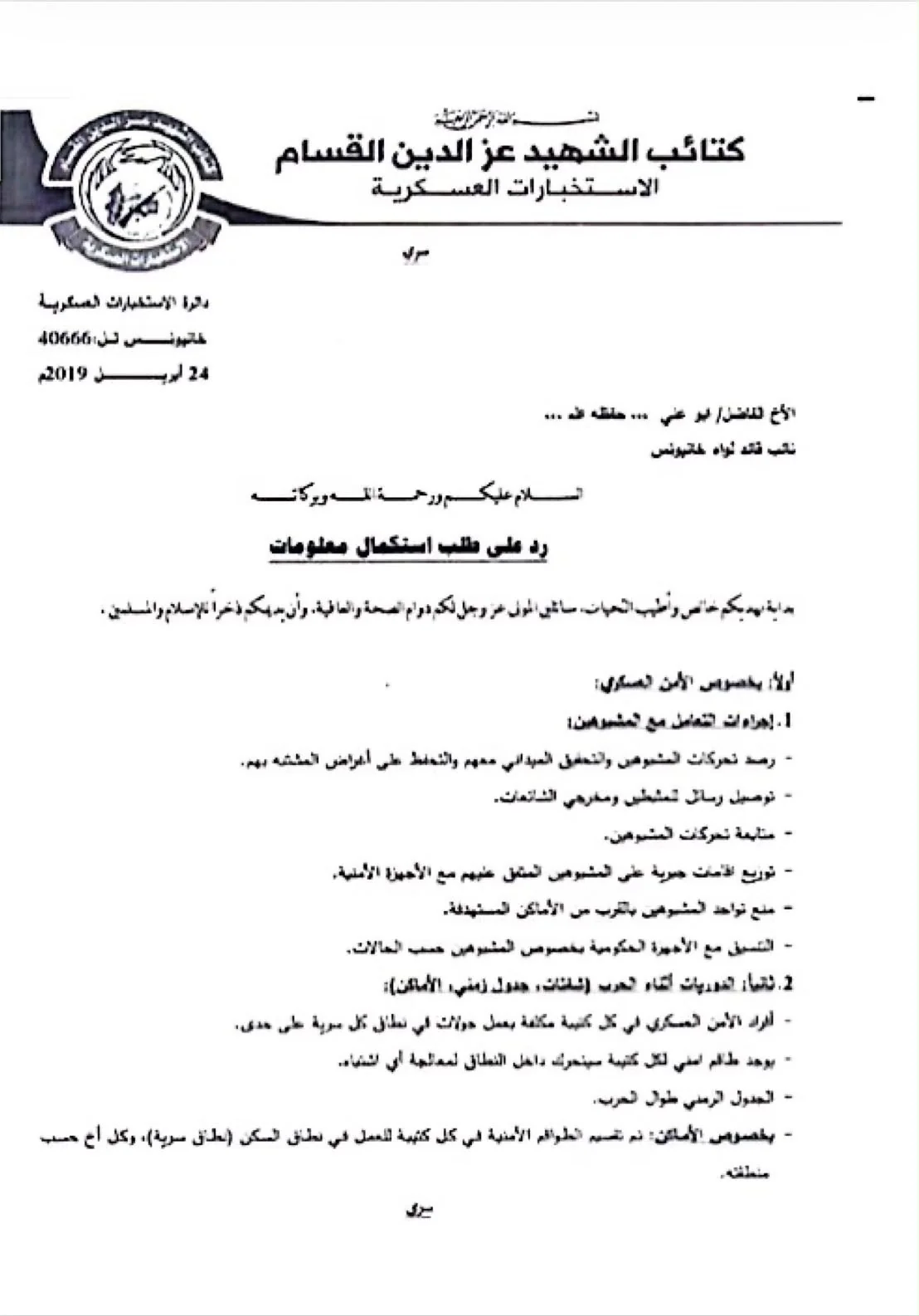
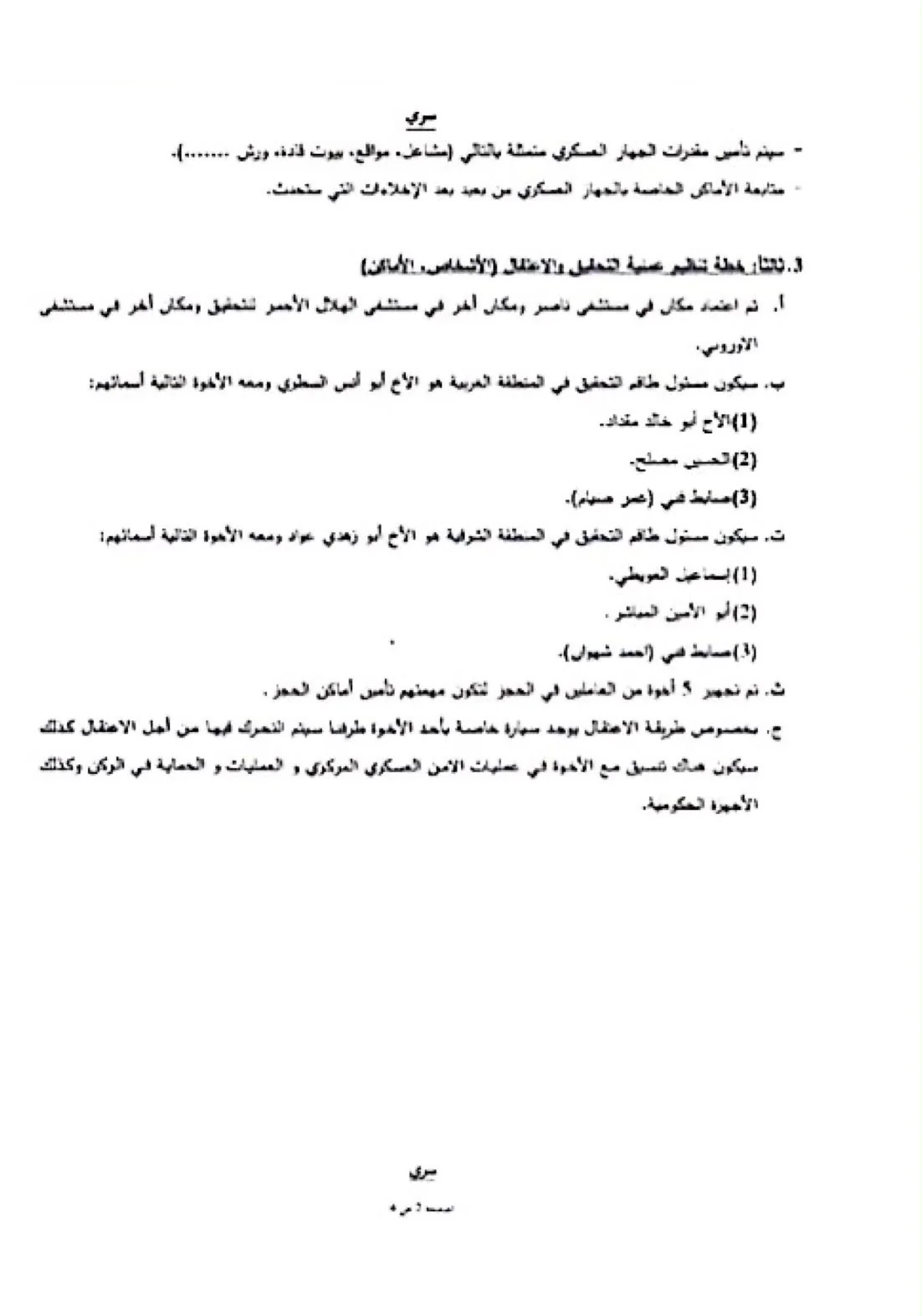
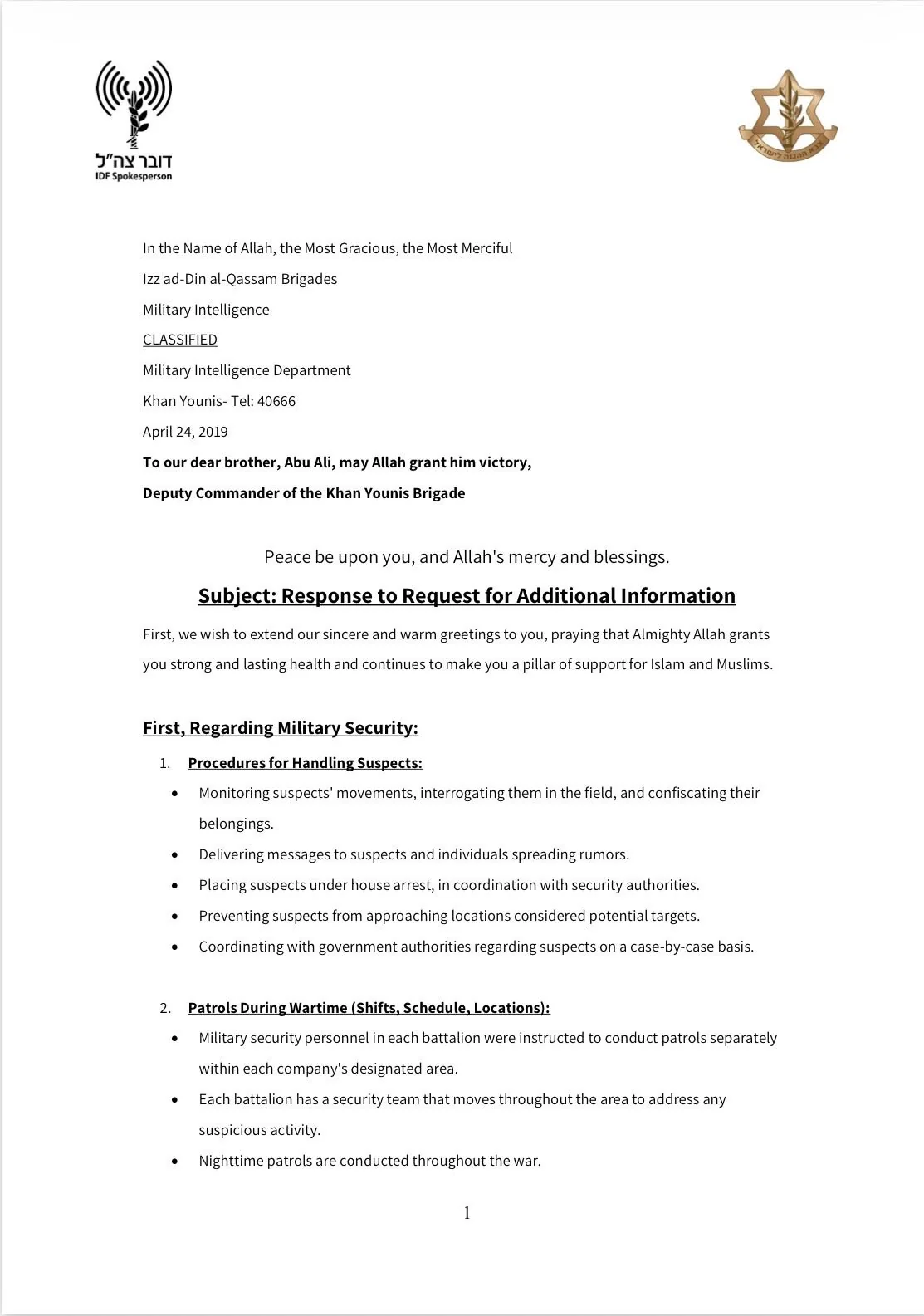
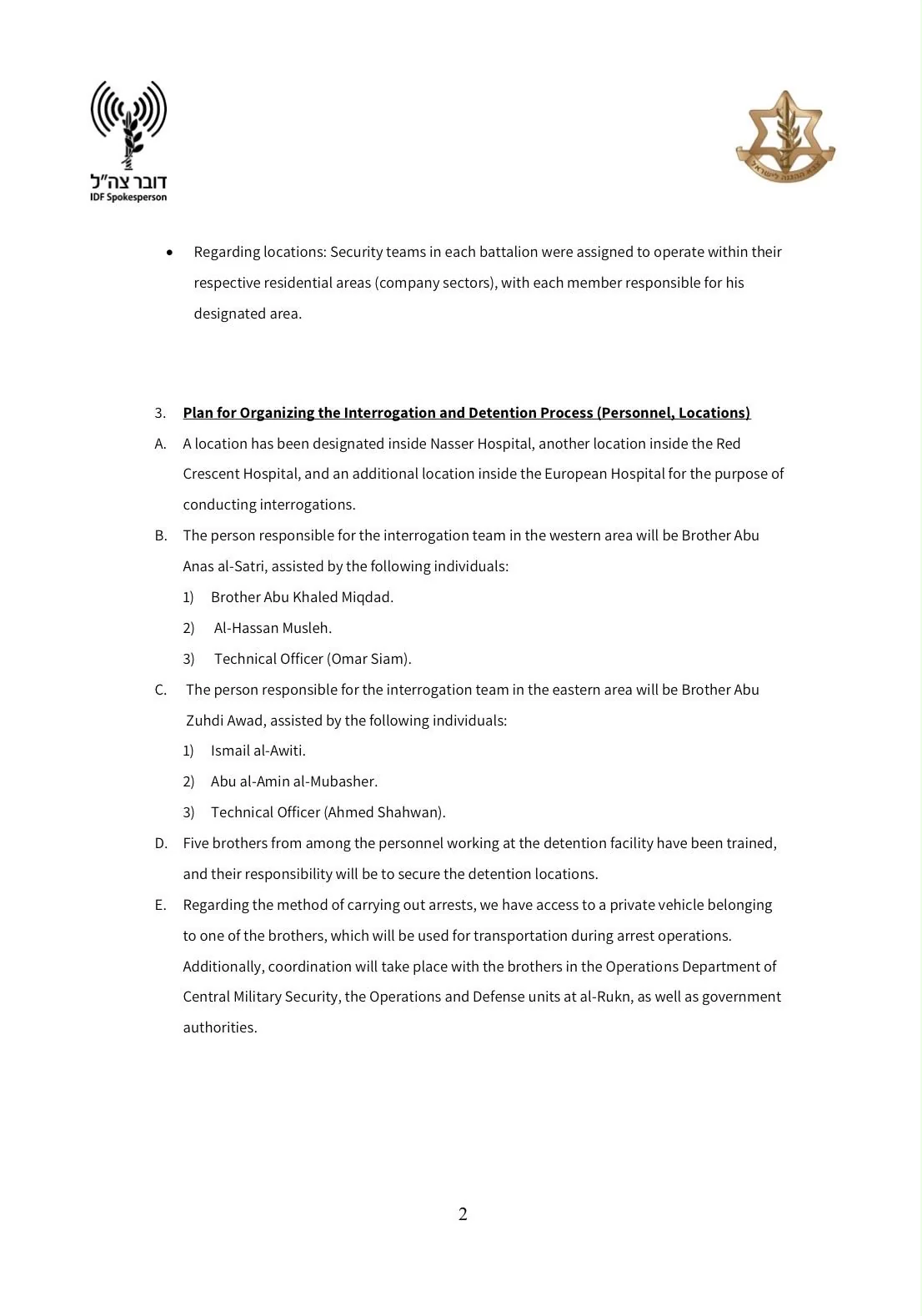
A reply at 14:20 UTC posted four images of the 2019 document: two pages in Arabic and the army's English translation of those pages (@IDF). In the army's translation, the memo is dated 24 April 2019, headed as Izz ad-Din al-Qassam Brigades Military Intelligence, marked classified, and issued by the Military Intelligence Department in Khan Younis. The army's post says the document was written by the deputy commander of Hamas's Khan Younis Brigade. The army's own translation addresses it to “our dear brother, Abu Ali… Deputy Commander of the Khan Younis Brigade,” as a “Response to Request for Additional Information.” The pages released do not say where the document was found; the claim that it was found near a battalion deputy commander's safe house is the army's.
Section 3 of the translated memo, “Plan for Organizing the Interrogation and Detention Process (Personnel, Locations),” is the passage the army is using to support its interrogation-site claim for Nasser. It says:
A. A location has been designated inside Nasser Hospital, another location inside the Red Crescent Hospital, and an additional location inside the European Hospital for the purpose of conducting interrogations.
The same section names those it says were responsible for the interrogation teams: in the western area, “Brother Abu Anas al-Satri,” assisted by Abu Khaled Miqdad, Al-Hassan Musleh and technical officer Omar Siam; in the eastern area, “Brother Abu Zuhdi Awad,” assisted by Ismail al-Awiti, Abu al-Amin al-Mubasher and technical officer Ahmed Shahwan. It says five trained personnel would secure the detention locations, and that a private vehicle would be used for arrests, with coordination through Central Military Security and government authorities.
If the memo is authentic, it is still a document from April 2019 — more than seven years before this strike. It does not name Mohammed Abu Ismail. It does not show who was in the surgical building on the night of 12 November 2026, or whether the second floor was then a headquarters closed to civilians, which is the justification the army gave for the strike. It is offered as support for a general claim, already made in the army's first post on the 12th, that Hamas used Nasser for “interrogations and torture.” A 2019 protocol designating a location for interrogations is not, on its face, evidence of what happened that night.
The same thread then posted a second document, which the army dates to 2020 and says was found near Shifa Hospital (1/3, 2/3, 3/3). In the army's English translation, it is a memo from a “Department of National and Islamic Organizations” about “Islamic Jihad's request for the allocation of space within the Ministry of Health.” It discusses activity at Shifa, Al-Rantisi and Kamal Adwan hospitals, including mortar shells, an operations room and the filming of rocket launches. It does not mention Nasser Hospital. Like the 2019 memo, it has not been independently verified.
Commentary. The memo is dated 2019, yet it was released on 13 November 2026 — the day after the strike, and after AP, AFP and DW had reported that no evidence had been produced. Releasing a document of that age at the moment a strike needs justifying is a pattern: obvious once you know it, but not obviously obvious. The same problem of presentation appears with the 2022 Sinwar memo: what was shown were fragments — an image said to have been found on a computer, and a phone photograph of a page in a sleeve — not the full original in context. Release the originals in full, with provenance (where, when and by whom they were seized) and chain of custody, so they can be independently examined.
What the Gaza side published
- The media office, on Telegram at 07:08 UTC (statement, Arabic): six killed, among them Dr Rizq Ahmed Abu Shaira and a 13-year-old; more than 25 injured; 793 attacks on health care and 1,725 medical staff killed by its count. It blames Israel and the US administration, questions the role of the Board of Peace and Gaza's national administrative committee, recalls the August 2025 double strike on Nasser, and calls on journalists to step up coverage with testimonies, pictures, “designs” and videos. verified (that it said this)
- The education ministry (statement): the 13-year-old was Jihad Naeem Abu Tilkh, an eighth-grader, the eighth pupil it says was killed in November. reported
- The health ministry (statement): condemns the strike on the surgical building and asks for protection of hospitals. reported
- Ismail al-Thawabteh, the media office's director, on X (post, Arabic): a general appeal — “stop the killing machine… stop the genocide” — without naming Nasser. verified
The Board of Peace, in between
Its statement (X) describes the dispute even-handedly — “Hamas alleges deliberate Israeli attacks on hospitals, Israel maintains that Hamas exploits these facilities” — then takes a side on the facts: it “strongly condemns Hamas's continued exploitation of hospitals.” It condemns no Israeli act, and asks “all parties” to cede authority to the Board itself. verified
Who got heard
About 280 to one on X. Part of that is plain audience size — @IDF has 54 times the followers — and part is language: the Gaza post is in Arabic. Even per follower, though, the army's posts reached about five times further. The first full account most English-language readers met on X was the army's; the Gaza statement with names and numbers was on Telegram, in Arabic, seen by a few hundred.
| Account | Posts | Followers | Views, 12 Nov evening |
|---|---|---|---|
| @IDF (Israeli gov) | 3 (05:38, 08:26, 17:24 UTC) | ≈3.29 million | 67,147 + 233,377 + 62,313 = 362,837 |
| @BoardOfPeace | 1 (16:15 UTC) | ≈186,000 | 357,230 |
| @ismailalthwabta (Hamas-run gov) | 1 (14:50 UTC) | ≈61,000 | 1,305 |
| Media office on Telegram | 3 (07:08–07:14 UTC) | — | 266 · 311 · 327 |
What the law says
Hospitals are protected. They lose that protection only if used, outside their humanitarian function, to commit acts harmful to the enemy — and even then only after a warning, with a reasonable time limit where appropriate, has gone unheeded (ICRC, customary rule 28). The attack must still be proportionate: the expected harm to patients and staff weighed against the military advantage. So the questions here are the ones in the table: was the second floor used militarily, was a warning given and ignored, and was killing a surgeon and patients in a working surgical building proportionate to the target. None is answered by either side's posts.
Even if he was there: why then, why there?
Grant the army's account in full — the commander was in that room. The law still asks more than “was he there?”:
- Every feasible precaution in the choice of means and methods of attack, to avoid or at least minimise harm to civilians (ICRC rule 17), and constant care to spare them (rule 15). Timing is a method. So is waiting.
- Proportionality: no attack where the expected civilian harm is excessive against the concrete military advantage (rule 14).
Which leaves questions only the army can answer:
- Why 00:30? The surgeon who survived says staff had just finished work and were going to sleep in the same building. A strike at night finds the most people in their beds. Israeli security officials told Ynet the hospital functions largely as a day-treatment facility, leaving fewer civilians present during evening and nighttime hours, when they believed Hamas personnel were using parts of the complex.
- Why the surgical building? Patients after surgery and in intensive care can't run, whatever the warning. A warning to evacuate a hospital floor means something different when the people on it are on drips.
- Why not wait? The army says it used aerial surveillance before the strike. If it could see him, could it have struck him outside, on the road, at another hour? It hasn't said why it couldn't.
- Why two missiles? The hospital says one didn't explode. What was the munition, and what blast was it expected to have inside a ward? The same officials told Ynet a drone fired two or three missiles, directed by the Southern Command's fire centre using Shin Bet intelligence.
The army's likely answers, to be fair to them: commanders who live in hospitals rarely leave them; a window may not come twice; a precision munition aimed at one room is the precaution. Those are arguments, and they may hold. But they're for the army to make on the record, with evidence, and for an independent body to test — not for a timeline to assume. open
How to verify what really happened
Neither side's posts settle it. These would, and most can be asked for today:
- The names. The full list of the six dead with ages and roles — staff, patient or companion — from the health ministry, checked against hospital records, funerals and families. One name is already confirmed by a colleague on the BBC; one by the education ministry.
- The commander. Was Mohammed Abu Ismail killed? Hamas sometimes confirms its commanders' deaths, often late; the army promised “further updates.” If he survived or wasn't there, the case collapses. If he died, it starts — it doesn't end.
- The warning. The army released audio it says is a warning to a senior health official. When was the call, to whom, what was said, how long before the strike? The official can be named and asked; the hospital director says nothing came.
- The munition. Agencies photographed what appears to be the unexploded missile. Its markings identify the weapon and its expected blast — which speaks directly to proportionality inside a ward.
- The room. The army's diagram marks three commanders' rooms on the second floor. Did the strike hit those rooms or the surgical wards and the medics' sleeping area BBC filmed? Footage can be geolocated against the army's own satellite image.
- The second floor before the strike. Staff, patients and visitors know whether a corridor was closed to civilians. Independent interviews — WHO, the ICRC, journalists — could establish it.
- An independent look. WHO and OCHA can visit; Israel can let foreign journalists in, which it doesn't; the army's legal review (its Fact-Finding Assessment Mechanism) can be asked whether it is examining the strike and to publish its finding.
- The documents. Independent authentication of the 2019 and 2020 memos the army released on 13 November — the original files, how they were found, and whether the pages posted are complete.
We'll record answers here as they come, from either side. open
Nasser before
The hospital's director says this is the seventh time Nasser has been hit in the war. In August 2025, a double strike killed 22 people including journalists and rescuers — see our record of it. The WHO says it has documented 1,056 attacks on health care in Gaza in three years, with 1,010 deaths (via BBC).
Ynet also cites an earlier Médecins Sans Frontières account: MSF suspended its work at Nasser in February after staff and patients reported seeing armed men, some of them masked, in various parts of the complex, though not in the areas where its own teams were operating, and resumed work in April. MSF said at the time that the situation had worsened after the ceasefire, with a pattern of intimidation, arbitrary arrests of patients and suspected movement of weapons. That is earlier testimony about the compound, not evidence of who was in the surgical building on the night of 12 November.
The original posts, word for word
As published, unedited; each links to the original, and each is archived with its view count and a SHA-256 hash (manifest). The army's original statement is the Hebrew post on @idfonline, given first; the English @IDF posts follow. Opening Hebrew is quoted verbatim. Translations from Arabic are ours.
Israeli army, Hebrew account (@idfonline) — primary source for the army's claim — 12 Nov, 08:13 UTC · original
צה"ל ושב"כ תקפו את מפקד חטיבת חאן יונס של ארגון הטרור חמאס
בתקיפה ממוקדת במהלך הלילה, צה"ל ושב"כ תקפו את המחבל מחמד אבו איסמעיל ששימש כמפקד חטיבת חאן יונס ומחבלים נוספים שהסתתרו בבית החולים "נאצר" בח'אן יונס שבדרום רצועת עזה.
Opening lines, as published, unedited. The English-language @IDF post at 08:26 UTC (post 2 below) is a later version of the same claim.
Israeli army, post 1 — 12 Nov, 05:38 UTC · original
🎯 STRUCK: A senior Hamas terrorist and additional terrorists operating within Nasser Hospital in Khan Yunis, southern Gaza, to eliminate the threat they posed.
Hamas used the hospital complex as a hub for military and terrorist activities against IDF troops and Israel, including:
• Storing weapons.
• Conducting interrogations and torture.
• Operating command-and-control rooms.
• Using hospital facilities as observation posts and shelters for terrorists.
Hamas’ use of the hospital for military purposes constitutes a blatant violation of international law and endangers patients, medical personnel & civilians.
Further updates on its results will follow.
Israeli army, post 2 — 12 Nov, 08:26 UTC · original
🎯 STRUCK: HAMAS BRIGADE COMMANDER HIDING IN A HOSPITAL WHO HELD NUMEROUS HOSTAGES CAPTIVE.
The Commander of Hamas’ Khan Yunis Brigade Muhammad Abu Ismail & additional terrorists hiding inside of the Nasser Hospital were struck in a targeted IDF & ISA strike in southern Gaza.
Abu Ismail was responsible for directing terrorist attacks against Israeli civilians & IDF troops and for holding numerous hostages captive throughout the war.
Hamas turned the hospital complex into a headquarters to advance dozens of terrorist attacks and restore the brigade’s terror capabilities. Additionally, dozens of hostages were held captive within the hospital.
Prior to the strike, advance warnings were issued to the civilian population & precision-guided munitions and aerial surveillance assets were employed to minimize the risk of harm to civilians.
Israeli army, post 3 — 12 Nov, 17:24 UTC · original
‼️🏥 Hamas’ exploitation of the Nasser Hospital: The hospital’s second floor serves as a Hamas military HQ, where civilians are not permitted to enter, as it is used by Hamas commanders, including Muhammad Abu Ismail, the Khan Yunis Brigade Commander who was targeted in the strike earlier today.
Dozens of hostages were held captive at the Nasser Hospital, and Muhammad Abu Ismail was responsible for holding numerous of them, including: Nimrod Cohen, Matan Zangauker, Edan Alexander, Avera Mengistu, Colonel Asaf Hamami, Staff Sergeant Oz Daniel & Captain Omer Neutra.
The strike was specifically directed at the room from which the brigade commander & the other terrorist were conducting military activities. Prior to the strike, the IDF warned on several occasions that the military activity at the hospital be halted. Despite these warnings, the activity at the hospital did not cease.
Board of Peace — 12 Nov, 16:15 UTC (posted as an image of this text) · original
The tragic loss of life following an Israeli strike on Nasser Hospital in Khan Younis underscores precisely why President Trump's Comprehensive Peace Plan must be implemented immediately without further delay. Otherwise, we will continue to see tragedies in which Hamas alleges deliberate Israeli attacks on hospitals, Israel maintains that Hamas exploits these facilities for terrorist operations, and innocent Gazans ultimately pay the price.
The Board of Peace deplores the death of any civilians and strongly condemns Hamas's continued exploitation of hospitals and other critical civilian infrastructure for military purposes. Both Israel and Hamas must immediately honor their commitments under the Comprehensive Peace Plan, including protecting civilians, maintaining the ceasefire, and advancing Gaza's demilitarization.
The Board of Peace has established a strategic framework to ensure Gazans can live safely and access essential medical care in secure, demilitarized facilities. All parties must cede the necessary authority and operational space to the Board of Peace to implement this framework without further obstruction or delay.
Ismail al-Thawabteh, Gaza media office — 12 Nov, 14:50 UTC (Arabic) · original
الاحتلال الإسرائيلي يُصعّد القتل والإبادة في قطاع غزة!
ما يجري في غزة استمرار لسياسة القتل والتدمير والاستهداف الممنهج، وسط تصاعد الاعتداءات على المدنيين، وقصف المستشفيات، وقتل الأطباء والأطفال، وتفاقم الكارثة الإنسانية.
يواصل الاحتلال استباحة الدم الفلسطيني، مستفيداً من غياب المحاسبة الدولية وعجز المجتمع الدولي ومجلس السلام عن وقف الجرائم وحماية المدنيين.
إن استمرار هذه الجرائم يحمّل العالم مسؤولية أخلاقية وقانونية وتاريخية. فحياة شعبنا ليست ورقة في حسابات السياسة، ودماء أبنائه ليست أرقاماً عابرة.
أوقفوا آلة القتل.. أوقفوا الإبادة.. وأنقذوا غزة! #غزة
د. إسماعيل إبراهيم الثوابتة
مدير عام المكتب الإعلامي الحكومي
قطاع غزة- فلسطين
Our translation:
The Israeli occupation is escalating the killing and the genocide in the Gaza Strip!
What is happening in Gaza is a continuation of the policy of killing, destruction and systematic targeting, amid escalating attacks on civilians, the bombing of hospitals, the killing of doctors and children, and a worsening humanitarian catastrophe.
The occupation continues to treat Palestinian blood as fair game, taking advantage of the absence of international accountability and the inability of the international community and the Board of Peace to stop the crimes and protect civilians.
The continuation of these crimes places a moral, legal and historic responsibility on the world. Our people's lives are not a card in political calculations, and the blood of its sons is not passing numbers.
Stop the killing machine.. stop the genocide.. and save Gaza! #Gaza
Dr. Ismail Ibrahim al-Thawabteh, Director General of the Government Media Office, Gaza Strip – Palestine
The image attached to the post has the same text but says “the Security Council” where the post says “the Board of Peace”.
The media office's full statement on Telegram, with its figures, is archived in Arabic (original).
The record — 25 sources
Date, publication and headline for each source, as the source itself published them, grouped by stance. Sorted by publication date. 22 of 25 dated; a blank means the publisher's page didn't expose it, and we don't guess.
Official government sources — 11 sources
Exercise extra caution. The Israeli government's own statements and the pro-Israel advocacy that amplifies them, kept apart from the record above. Israel is a party to the war, its public-diplomacy budget roughly quintupled to $730 million in 2026, and its first accounts of several incidents here were later contradicted — so read them as one side's case, and check them. Labels describe each source's stance; propaganda marks what we cite as an example of denial, not as evidence.
#NarrativeShifter — Timing is the message (satire)
Sharper laws require sharper satire
Marsita the Ultra’s satirical infographic, under the heading “Timing is the message” and the hashtag #NarrativeShifter, is captioned: “When a document from 2019 is revealed to change the narrative.” It pairs events by timing: the Global Sumud flotilla interception (1–2 October 2025) with the Manchester synagogue attack (2 October 2025); the strike on Nasser Hospital (12 November 2026) with the army’s release, the next day, of a 2019 Hamas document; and the start of the Gaza ceasefire (10 October 2025) with the publication of the 2022 Sinwar memo (12 October 2025).
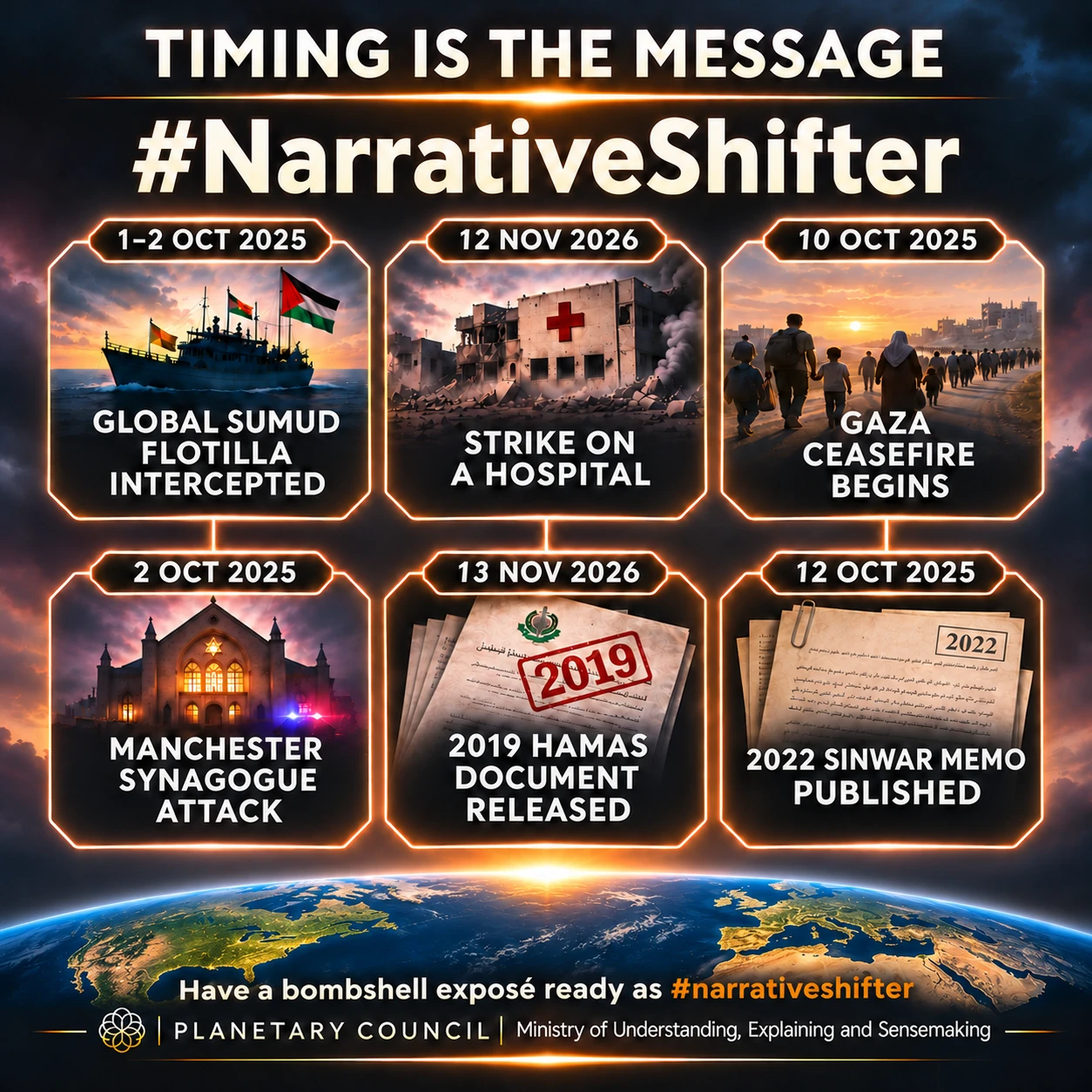
Commentary. The image is about the timing of releases, not about inventing the events it pairs. The hospital-strike column is the same timing question recorded in The army's document (13 Nov); the ceasefire column points to the 2022 Sinwar memo. The Manchester synagogue attack of 2 October 2025 was a real attack, with victims; nothing here suggests it was staged.
Satire by Marsita the Ultra / Ministry of Memes & Better Propaganda.