H4The 2022 Sinwar memo: what is reported, what we don't know
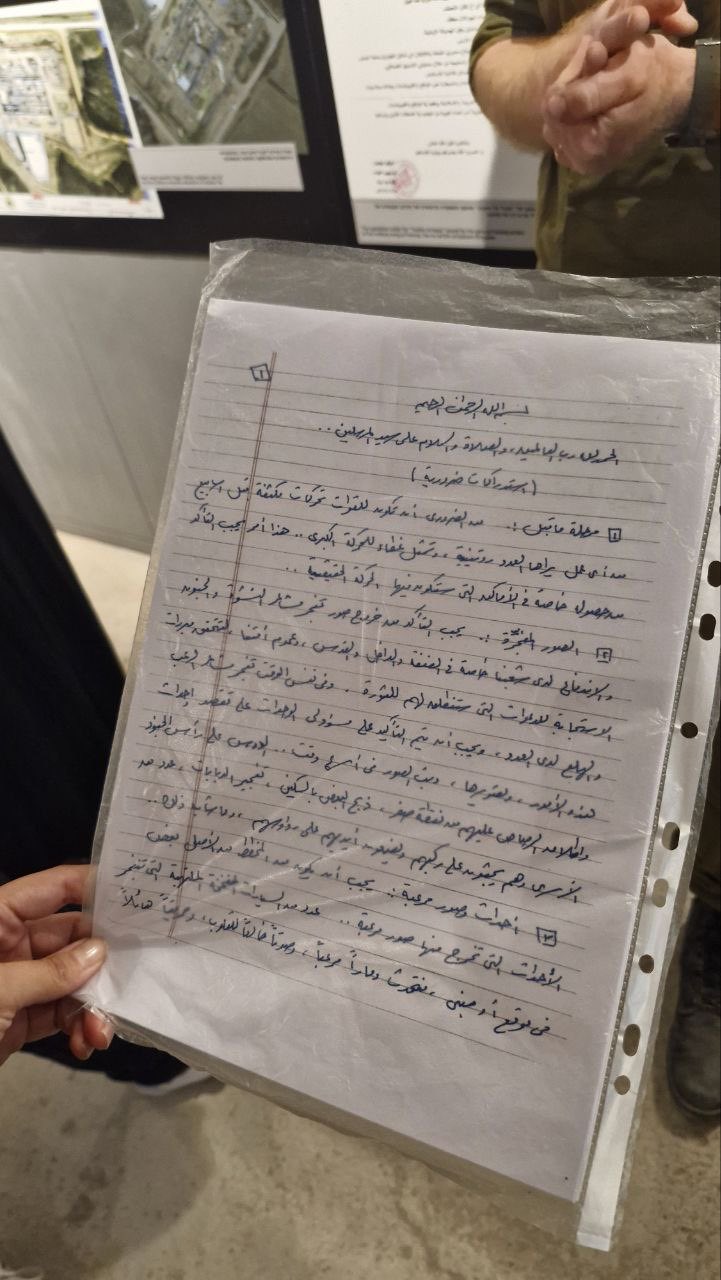
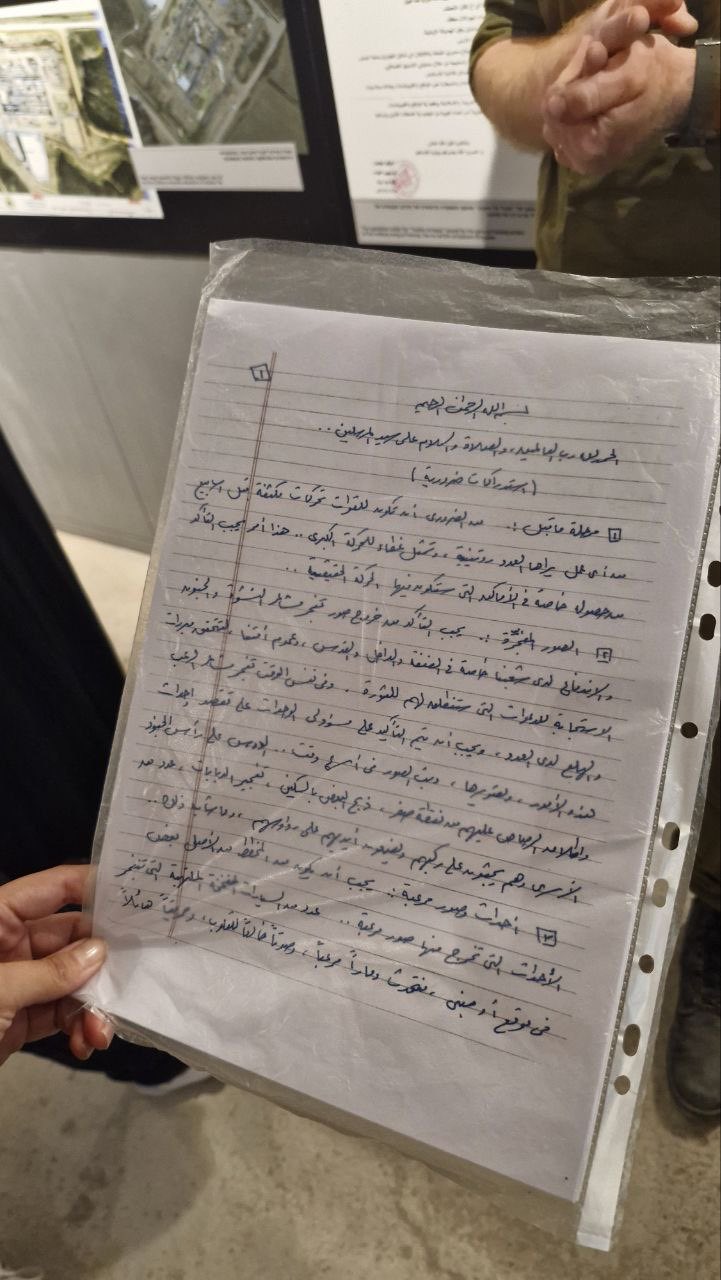
- No original files released for basic digital forensics. No uncropped page, no file, no EXIF, no hash, no device — only crops (one edited in Photoshop) and a phone photo of a paper page.
- Selective framing. The independent translation puts the knife line on soldiers; Israel's institute and Foreign Ministry made it “civilians.”
- Timed release. The report was ready by 3 August 2025, held for ten weeks, and published days after the ceasefire deal.
Israeli officials say a six-page handwritten Arabic memo dated 24 August 2022, attributed to Hamas Gaza leader Yahya Sinwar, sets out the plan for the 7 October 2023 attack: bulldozed fence breaches, waves of attackers, other factions told only after it began, and deliberately filmed violence including the burning of “an entire neighborhood, kibbutz, or something similar.” According to the New York Times (11 October 2025), an Israeli military unit found it in May 2025 as an image on an air-gapped computer used by his brother Muhammad Sinwar; every step from the bunker to publication — the find, the copy, the handwriting samples, the intercepts said to corroborate it — passed through the Israeli state, and no independent forensic examination of the file or the device has been made public.
Scan or photograph?
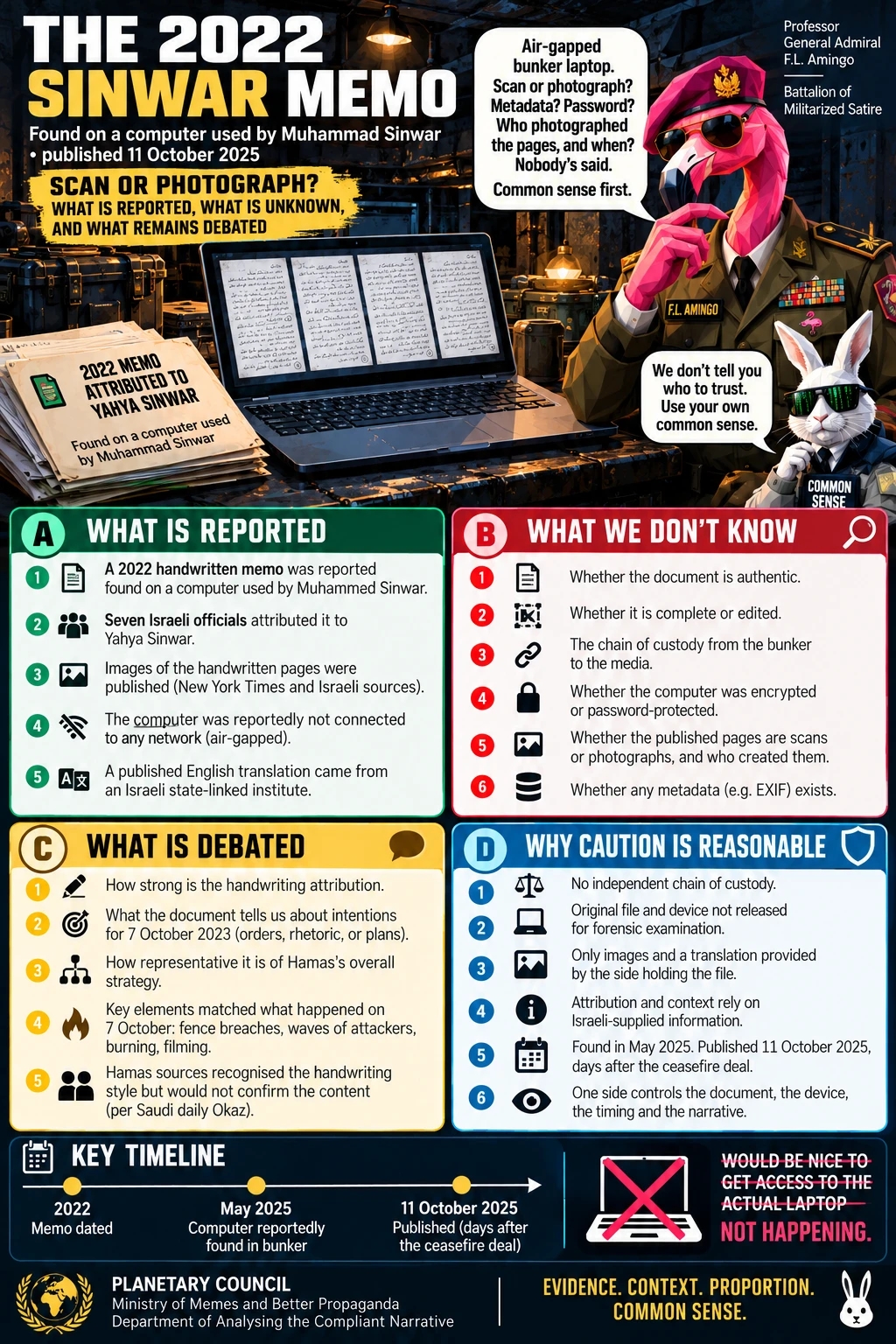
Exhibit: page 1, on paper
How the memo surfaced
| Date | Event | Status |
|---|---|---|
| 24 Aug 2022 | Date written on the memo | reported |
| 7 Oct 2023 | Hamas-led attack on southern Israel | verified |
| 16 Oct 2024 | Yahya Sinwar killed by Israeli forces in Rafah | verified |
| May 2025 | An Israeli military unit enters an underground complex used by Muhammad Sinwar after he is killed, and finds an air-gapped computer holding an image of the six-page memo | NYT via Kurdistan24 reported |
| 9 Oct 2025 | Date printed on the Meir Amit institute's report | report PDF verified |
| 11 Oct 2025 | New York Times publishes, days after the Gaza ceasefire deal and before the last living hostages are released | NYT reported |
| 12 Oct 2025 | Institute publishes images and its translation; Israel's Foreign Ministry posts a page on X | Meir Amit, @IsraelMFA verified |
| 12 Jul 2026 | Israeli Channel 12 reports a second handwritten Sinwar document from August 2022 (anticipating even a nuclear response) | reported |
What the memo says — two translations
There are two public translations: the New York Times' own, and the Israeli institute's. Both work from images supplied by Israel.
| New York Times translation | Amit Institute (Israeli state-linked) translation |
|---|---|
| “Two or three operations, in which an entire neighborhood, kibbutz, or something similar will be burned, must be prepared” — with “gasoline or diesel from a tanker.” | “Preparations must be made for two or 3 operations whose objective is to burn entire neighborhoods, a kibbutz, and so on. Fuel or diesel will be sprayed on the site from a tanker.” |
| “Stomp on the heads of soldiers.” … “opening fire on soldiers at point-blank range, slaughtering some of them with knives, blowing up tanks.” | “stepping on the heads of soldiers, point-blank shootings, slaughtering people with knives, blowing up tanks, prisoners kneeling with their hands on their heads.” |
| “It needs to be affirmed to the unit commanders to undertake these actions intentionally, film them and broadcast images of them as fast as possible.” | “It must be emphasized to the unit commanders that these things are to be carried out deliberately. That is, to document and broadcast the images as quickly as possible.” |
— New York Times, 11 Oct 2025; Amit Institute report, pp. 4–15 verified
The NYT: “Although the memo does not explicitly mention plans to kidnap or kill civilians, it lays out orders for fighters to enter residential neighborhoods and set them on fire.”
What we noticed reading it
- Soldiers become “civilians.” In the NYT translation the knife line is about soldiers: “opening fire on soldiers at point-blank range, slaughtering some of them with knives.” The Israeli institute's version says “slaughtering people with knives”; its summary says the memo instructs operatives to film themselves “indiscriminately slaughtering civilians”; the Foreign Ministry's post says “the slaughter of civilians.” The burning of neighborhoods and kibbutzim is explicitly aimed at civilian communities; the knife line, in the independent translation, is not. verified
- The most-quoted line isn't from the memo. “Slaughter them. End the children of Israel” is, per the NYT, from an intercepted radio call on 7 October — a Gaza City commander called Abu al-Baraa, near Kibbutz Sa'ad — not from the memo. It circulates as a memo quote. verified
- Draft notes left in. Footnote 9 of the institute's published report reads, in full: “This is pretty much footnote 6.” Footnote 6 cites a reading of Sinwar's 2004 novel, not the memo. verified
- An open archive? Footnote 1: “The documents mentioned in this study can be viewed at the archives” of the institute. We found no report of an independent examiner doing so. open
Independence check: who touched it
| Link in the chain | Who | Independent of Israel? |
|---|---|---|
| Found the computer | A special Israeli military unit | No |
| Holds the computer and the file | Israeli military / intelligence; never released | No |
| Gave the NYT its copy | Israeli officials (seven, all anonymous) | No |
| Handwriting comparison | Sima Ankona, former Israeli police examiner, at the NYT's request — from images, against samples “that Israeli authorities had collected” | Examiner hired by the NYT; materials all Israeli |
| Translation 1 | The New York Times | Yes — but from an Israel-supplied image |
| Translation 2 and analysis | Amit (Meir Amit) Institute, within the Israeli Intelligence Heritage and Commemoration Center | No |
| “Corroborating” intercepts | Unit 8200, shared by three Israeli security officials; NYT reviewed and translated hours of recordings | No (content reviewed by NYT; provenance Israeli) |
| Assessment | Gazit Institute, affiliated with military intelligence (confidential) | No |
| Phrasing match | “Several words and phrases … appear in other Hamas documents previously reviewed by The Times” — themselves Israel-supplied | No |
| Hamas response | Media office did not answer the NYT; unnamed Hamas sources told Okaz they recognised the handwriting style but not the content; analyst Ibrahim Madhoun doubted it | Yes — and it doesn't confirm |
The only independent links are the NYT's translation, its handwriting examiner's opinion, and the unconfirmed Hamas reactions. Everything they were given came from one party to the war. Sources: NYT, Amit Institute, Okaz. verified
Do we have the six original pages? No.
We looked for every public copy of the memo and read the metadata of each, as of 29 Oct 2026. None is a complete, uncropped, original file with its EXIF data. verified
Our copies: English report (PDF) · Hebrew report (PDF) · Photoshop crop · Foreign Ministry photo · sources and SHA-256 hashes. Retrieved 29 Oct 2026, unaltered.
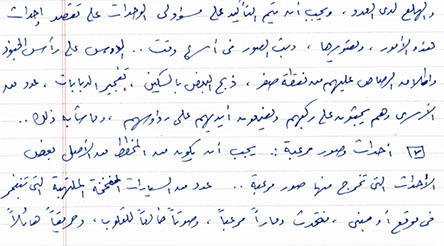
| Copy | What it is | Metadata |
|---|---|---|
| Amit Institute, English page | 15 cropped excerpts, 391–601 px wide; file names “word-image-…” — pasted in from a Word document. No full page. | None (PNG). Upload timestamps in the file names: 8 Oct 2025 |
| Amit Institute, Hebrew page | The same excerpts, uploaded earlier; no full page | Upload timestamps: 3 Aug 2025, 08:35 UTC |
| Amit Institute, header crop | 444 × 246 crop of page 1 | “Adobe Photoshop 26.8 (Macintosh)”, created 3 Aug 2025 10:59 and saved 11:00 (Israel time) — the only file with surviving metadata, and it records an edit, not a camera |
| Amit Institute, report PDF | 18 pages; the memo appears only as cropped excerpts (≈ 880 px wide) | The PDF now posted was generated on 22 Aug 2026 (macOS Quartz); the page was last modified the same day |
| Israel Foreign Ministry, X | One phone photo of page 1: a paper page in a plastic sleeve, held up in a room with display boards | None — X strips EXIF; 721 × 1280, re-encoded |
| The New York Times | “A copy” obtained from Israeli officials; the article as archived on 11 Oct 2025 shows no image of the memo | — |
| The original file and the computer | Held by Israel | Not released |
Two things follow. First, the institute had the memo cropped and its report prepared by 3 August 2025 — about ten weeks before it published on 12 October, days after the ceasefire deal. Second, the Foreign Ministry's photo shows a handwritten page on paper, while the NYT says the computer “held an image.” Either it is a printout of that image, or there is a paper original that nobody has accounted for.
What we don't know
- Are the page images scans or photographs — and who made them, when?
- Was the computer encrypted or password-protected, and how was it opened?
- Has any file metadata been disclosed? Has a forensic disk image with a hash been offered to anyone outside Israel?
- Does a paper original exist? The Foreign Ministry's photo shows page 1 on paper, in a sleeve. Is that a printout, or the original?
- What is the chain of custody from the bunker to the newsroom?
- The institute's appendix shows five images; the memo is described as six pages. Is anything missing?
- Which translation is right where they differ — soldiers, or “people”? The Arabic images are public; an independent Arabic reader could settle it.
- Where are the raw intercept recordings, and has anyone outside Israel authenticated them?
- Were other files on the same computer withheld?
- Why five months between recovery and publication — and why hold a report that was ready by 3 August until days after the ceasefire deal?
None of these is hard to answer for whoever holds the laptop.
How to weigh it
For authenticity: the handwriting comparison; Hamas sources recognising the style; instructions that match 7 October (bulldozed fence breaches, attack waves, factions joining later, homes burned, atrocities filmed and broadcast); handwriting fits Sinwar's known avoidance of electronics. For caution: one custodian (the Israeli military); Israeli-only attribution; a match made from images; no file, device or metadata; an Israeli translation that is harsher than the independent one; the timing; and the record — in September 2024 supposed Hamas documents about Sinwar, published by the Jewish Chronicle and Bild, were found to be forged or misrepresented, and people linked to the Prime Minister's office were arrested over the leak (FAIR).
Matching later events is what an authentic plan would do. A document written or edited after the fact would match too. Only access to the file and the device can tell the two apart.
The record — 10 sources
Date, publication and headline for each source, as the source itself published them, grouped by stance. Sorted by publication date. 9 of 10 dated; a blank means the publisher's page didn't expose it, and we don't guess.
Official government sources — 7 sources
Exercise extra caution. The Israeli government's own statements and the pro-Israel advocacy that amplifies them, kept apart from the record above. Israel is a party to the war, its public-diplomacy budget roughly quintupled to $730 million in 2026, and its first accounts of several incidents here were later contradicted — so read them as one side's case, and check them. Labels describe each source's stance; propaganda marks what we cite as an example of denial, not as evidence.