07Torture and sexual violence against Palestinian detainees
- Attack dogs set on shackled, blindfolded detainees — documented by the UN.
- Israeli whistleblowers described amputations caused by round-the-clock zip-tie restraints.
- The UN found the torture systematic — policy, not incidents.
According to UN OHCHR reporting and testimonies from released detainees, Palestinians held at Israel's Sde Teiman military detention facility were subjected to systematic torture and severe sexual and gender-based violence, including dogs being set on shackled detainees, with some testimonies collected by UN bodies and human-rights organizations alleging dog-involved sexual assault. Israeli whistleblowers who worked at the facility corroborated accounts of abuse in a CNN investigation, and UN experts described the reported treatment as flagrant violations of international law, while Israel has denied the specific allegations. A November 2025 investigation by Physicians for Human Rights–Israel (PHRI) documented at least 94 Palestinian deaths across Israeli detention facilities between 7 October 2023 and 31 August 2025; this wider custody record is featured below.
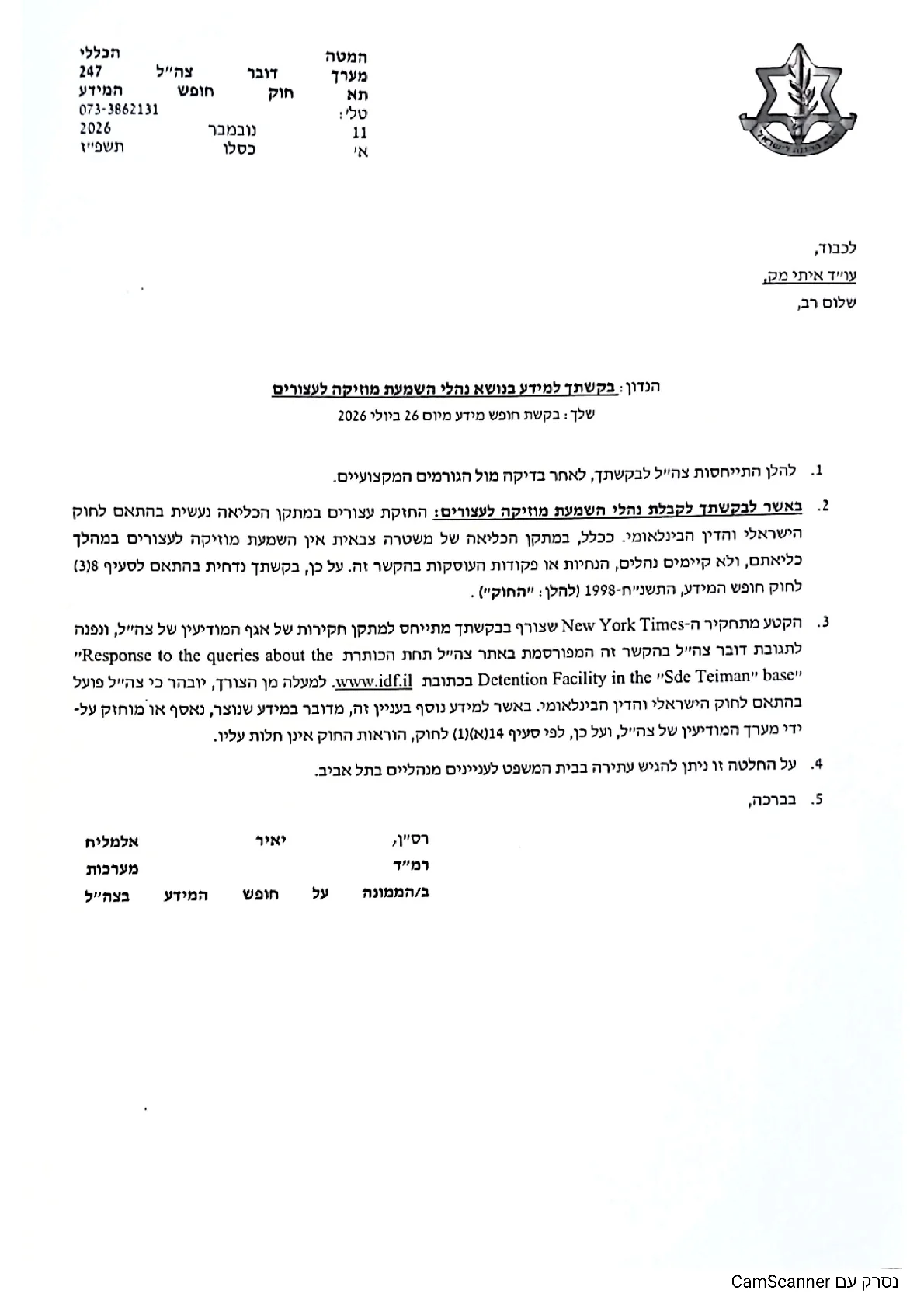
IDF Freedom of Information response, 11 November 2026
Featured evidence — Physicians for Human Rights–Israel
PHRI’s November 2025 investigation draws on official records, freedom-of-information responses, medical evidence and witness accounts across the Israeli detention system.
1. Research report · November 2025 · 28 pages
Deaths of Palestinians in Israeli Custody: Enforced Disappearances, Systematic Killings and Cover-Ups (PDF)
Examines deaths in military and prison-service custody, enforced disappearance, family notification, post-mortem examinations and accountability.
2. Supporting case documentation · November 2025 · 25 pages
Companion appendix: 73 identified deceased detainees (PDF)
Records names, facilities, dates, medical findings and available testimony.
| Figure | Meaning | Scope |
|---|---|---|
| 94+ | Documented deaths in custody | 7 October 2023 – 31 August 2025; multiple facilities |
| 73 | Identified deceased detainees | Cases documented in the companion appendix |
| 21 | Deaths without verified identities | 94 documented deaths minus 73 identified cases |
Documented minimum figures, not a complete death toll. A death in custody does not by itself establish homicide or torture as the cause. Medical findings, witness allegations and judicial determinations are distinct forms of evidence.
Scope of the evidence
The PHRI findings cover multiple Israeli detention facilities, not Sde Teiman alone. They concern the wider custody record and are not a count of deaths involving dogs. Both featured PDFs are indexed once each in the source table below.
Music at the facility, and a refused Freedom of Information request
On 12 November 2026, the Israeli human-rights lawyer Eitay Mack posted on X the Israeli army’s written response to a Freedom of Information request he had filed on 26 July 2026. He asked for the procedures for playing music to detainees (נהלי השמעת מוזיקה לעצורים). His post, in Hebrew:
ה-@nytimes פרסם עדויות עצירים פלסטינים ב"שדה תימן", שלפיהן הושמעה להם מוזיקה בעוצמה שמנעה שינה וגרמה לדימום מהאוזניים. בתגובה, דובר צה"ל מסר שמוזיקה הושמעה כדי למנוע תיאום בין העצירים. צה"ל מסרב לחשוף את הנוהל בנושא, בטענה שהמתקן מופעל על ידי מערך המודיעין, המוחרג מחוק חופש המידע
In unofficial translation, roughly: “The NYT published testimonies of Palestinian detainees at Sde Teiman that music was played at a volume that prevented sleep and caused bleeding from the ears. In response the IDF Spokesperson said music was played to prevent coordination between detainees. The IDF refuses to disclose the procedure, claiming the facility is operated by the Intelligence Directorate, which is exempt from the Freedom of Information Law.”
The testimonies Mack refers to were published in The New York Times’s investigation of 6 June 2024, “Inside Sde Teiman, the Base Where Israel Detains Gazans,” by Patrick Kingsley and Bilal Shbair. Former detainees described being taken to a separate enclosure they called the “disco room,” where, they said, extremely loud music prevented them from sleeping. One, identified as Mr. Bakr, told the Times he considered it a form of torture and that it was so painful that blood began to trickle from inside his ear. The Times recorded the Israeli military’s response: that the music was “not high and not harmful,” played within earshot of Israelis and Palestinians alike, and was meant to prevent detainees from easily conferring with each other before interrogation. The Times was not shown the interrogation area where the music was played.
The army’s letter, dated 11 November 2026, reference 247, is on General Staff / IDF Spokesperson Unit letterhead, from the Freedom of Information desk, addressed to Adv. Eitay Mack (עו"ד איתי מק), and signed by a Major on behalf of the official in charge of Freedom of Information in the IDF (ב/הממונה על חופש המידע בצה"ל). A scan of the Hebrew original is above. The English that follows is an unofficial translation of that letter, prepared for this page; it is not an official English version. The letter is the army’s account of its own decision, not an independent finding.
Unofficial translation of the IDF letter · translated from the Hebrew original of 11 November 2026, reference 247.
General Staff · IDF Spokesperson Unit · Freedom of Information Law desk
Tel: 073-3862131
Date: 11 November 2026 (1 Kislev 5787)
Reference: 247To: Adv. Eitay Mack
Dear Sir,Re: Your request for information concerning the procedures for playing music to detainees
Your request: Freedom of Information request dated 26 July 20261. The following is the IDF’s response to your request, after examination with the professional authorities.
2. Regarding your request to obtain the procedures for playing music to detainees: The holding of detainees at the detention facility is carried out in accordance with Israeli law and international law. As a general rule, at the Military Police detention facility there is no playing of music to detainees during their detention, and there are no procedures, directives or orders dealing with this matter. Accordingly, your request is rejected pursuant to section 8(3) of the Freedom of Information Law, 5758–1998 (hereinafter: “the Law”).
3. The excerpt from the New York Times investigation attached to your request relates to an interrogation facility of the IDF Intelligence Directorate, and we refer you to the IDF Spokesperson’s response on this matter, published on the IDF website under the title “Response to the queries about the Detention Facility in the ‘Sde Teiman’ base” at www.idf.il. Though it is unnecessary to do so, it is clarified that the IDF operates in accordance with Israeli law and international law. As for additional information on this matter, this is information that was created, collected or held by the IDF Intelligence Directorate, and therefore, pursuant to section 14(a)(1) of the Law, the provisions of the Law do not apply to it.
4. This decision may be challenged by filing a petition with the Administrative Affairs Court in Tel Aviv.
5. Respectfully,
Major, Head of Section, on behalf of the official in charge of Freedom of Information in the IDF.
The letter therefore does two things, which should be kept distinct. It rejects the request under section 8(3) on the ground that, as a general rule, music is not played to detainees at the Military Police detention facility and that no procedures, directives or orders on the subject exist. Separately, it says the New York Times excerpt relates to an Intelligence Directorate interrogation facility, points to the army’s already-published response on the Sde Teiman detention facility, and says that further information created, collected or held by the IDF Intelligence Directorate is exempt under section 14(a)(1), so the Law’s provisions do not apply to it. Mack’s post characterises that second limb as a refusal to disclose the procedure, on the claim that the facility is operated by the Intelligence Directorate and is therefore exempt.
The record — 20 sources
Date, publication and headline for each source, as the source itself published them, grouped by stance. Sorted by publication date. 20 of 20 dated; a blank means the publisher's page didn't expose it, and we don't guess.
Official government sources — 1 source
Exercise extra caution. The Israeli government's own statements and the pro-Israel advocacy that amplifies them, kept apart from the record above. Israel is a party to the war, its public-diplomacy budget roughly quintupled to $730 million in 2026, and its first accounts of several incidents here were later contradicted — so read them as one side's case, and check them. Labels describe each source's stance; propaganda marks what we cite as an example of denial, not as evidence.
| Date | Publication | Headline | |
|---|---|---|---|
| Israeli government & military · 1 | |||
| — | IDF statement | ||