07BAttack dogs: torture and reported rape of Palestinian detainees
- Reported rape involving dogs: Euro-Med published a witness account in 2024 and a separate survivor account in 2026.
- Dog attacks and intimidation are reported in detention facilities and during raids in Gaza and the West Bank.
- SOMO obtained 110 veterinary export certificates issued to Dutch dog companies for exports to Israel; 100 were for Four Winds K9.
Euro-Med Human Rights Monitor published a witness account in June 2024 and a survivor account in April 2026 alleging that Israeli forces used dogs to rape Palestinian detainees. Its reporting also describes dogs used to attack and intimidate people during detention and raids. A 5 November 2026 investigation by Rajaa Natour for The Electronic Intifada examines the European supply chain behind military dogs; SOMO’s research documents Dutch veterinary export certificates and the absence of military-style licensing controls for these exports. Joshua Carroll’s November 2025 report for Novara Media covers testimony collected by the Palestinian Centre for Human Rights; Nicholas Kristof’s New York Times Opinion column and its follow-up are linked below alongside Caitlin Johnstone’s commentary.
Planetary Council — a call for investigation

Reported rape involving dogs — two published accounts
June 2024 — witness account. Euro-Med published testimony from lawyer Fadi Saif al-Din Bakr, who said he saw soldiers restrain another detainee and use dogs to rape him. Read Euro-Med’s account and attribution →
April 2026 — survivor account. Euro-Med published testimony from Wajdi, 43, who alleged that he was raped by soldiers and a dog during interrogation. Read the later report →
These are published testimonies recorded by Euro-Med, not judicial findings. Repetition of the same account in later articles is not an additional incident. The accounts do not establish a total number of victims or locate every incident at Sde Teiman.
Further reporting, opinion and follow-up
Novara Media — reporting. Joshua Carroll’s 25 November 2025 article describes a former detainee’s account collected by PCHR and interviews PCHR advocacy officer Basel Alsourani. It also revisits previously published testimony, including Bakr’s account. Read the report →
New York Times Opinion — Nicholas Kristof. Read the column (gift link) → · Your Questions About Nicholas Kristof’s Column on Palestinians and Sexual Assault (follow-up gift link) →
Caitlin Johnstone — commentary, republished by Brave New Europe. Read Johnstone’s commentary →
Several articles revisit the same testimonies. Distinct publications are listed once each; their number is not a count of separate assaults.
The New York Times stands by the column
Nicholas Kristof’s Opinion column of 11 May 2026, already linked above, was followed by claims that The New York Times would retract it, and later by claims that the newsroom had distanced itself from it. The paper’s communications account answered both in public.
12 May 2026 — the retraction rumour. At 2:07 a.m. UK time (Europe/London), the journalist David Shuster posted on X:
Hearing from longtime friends @nytimes there are already discussions, including up the masthead, about retracting @NickKristof column. Issues with source credibility and lack of evidence. No indications the Kristof sourcing mistakes were deliberate. Still problematic:
The New York Times communications account, @NYTimesPR, quoted that post at 6:50 p.m. UK time the same day and published a statement from spokesperson Charlie Stadtlander:
“There is no truth to this at all. Nicholas Kristof is a two-time Pulitzer Prize-winning journalist who has reported on sexual violence for decades, and is widely regarded as one of the world’s best on-the-ground reporters documenting and bearing witness to sexual abuse experienced by women and men in war and conflict zones. He traveled to the region to report firsthand on the stories of Palestinians who suffered abuse, and his article collects accounts in the victims’ own words, backed by independent studies.”
— Charlie Stadtlander, a spokesperson for The New York Times
Open the @NYTimesPR statement of 12 May 2026 on X ↗
9 July 2026 — the Kahn interview. On 8 July at 9:47 p.m. UK time, Eliana Johnson posted on X a Washington Free Beacon article by Ira Stoll headed “Top New York Times Editor Joe Kahn Distances Newsroom From Kristof Dog-Rape Column — ‘Wouldn’t Have’ Run It.” At 1:30 a.m. UK time on 9 July, @NYTimesPR quoted that post and wrote: “This is inaccurate and taken out of context. Here’s the full quote Joe Kahn gave when asked if Nick Kristof’s column would have run in the news report:”
“I mean it’s a little bit of a hypothetical. Nick, as you know, is an opinion columnist. He’s also a very accomplished New York Times foreign correspondent who made his name in various overseas assignments, in China, around the world, reporting out of Africa, Japan. He’s a very accomplished journalist. In his opinion column he also does a lot of original reporting, on the road. So Nick has his own brand and area of expertise. And that piece was edited by our opinion section, it wasn’t edited by our newsroom. So it’s distinct but it’s not a categorical difference.
It’s impossible to say whether we would have done the identical piece. We probably wouldn’t have because it’s not — you know Nick has a particular focus on human rights and war and it is kind of part of his area of focus as a columnist. So to say, ‘would we have done that exact piece?’ No, we wouldn’t have done that exact piece. But we have reported very similarly on abuses in the Israeli prison system.
We have also reported on sexual abuses by Hamas against Israeli prisoners or against Israelis during the October 7 attack. So we’ve reported on sexual abuse on both sides of that, and every time we do it excites a lot of controversy. Nick’s piece did as well. This one happened to be done by the Opinion section, by him as a columnist.
You know, I have confidence in my opinion colleagues that they edit with rigor.”
Open the @NYTimesPR statement of 9 July 2026 on X ↗
In the 21 May follow-up already linked above, Opinion editor Kathleen Kingsbury wrote that after publication the paper reviewed the factual challenges that readers and others had raised, and that “Editors found no errors.”
On 14 May 2026, Prime Minister Benjamin Netanyahu and Foreign Minister Gideon Sa’ar said they had instructed the initiation of a defamation lawsuit against The New York Times over the column (Reuters; BBC). The Times said any such claim would be “without merit.” As far as public reporting shows, no lawsuit has been filed: a June 2026 Times of Israel follow-up found no indication that Israel had taken concrete steps to bring a case, and later coverage has not reported a filing. The Times has not retracted the column or added an editor’s note withdrawing it.
Commentary. The column comes from a two-time Pulitzer Prize winner and was carefully researched — that is how the Times itself has described Kristof and the piece. The paper has now defended it twice in public: first against a rumour of retraction, and then against a framing of Kahn’s remarks as a distancing. There were reports of a retraction, and of a lawsuit; as far as the public record shows, neither a retraction nor a filed case followed. Given the multiple corroborating sources already gathered on this page, our assessment is that the core allegations are likely true. It would still be valuable to hear directly from the people involved, or to see footage; getting footage out of Israeli detention is not easy.
New reporting — 5 November 2026
Exported to Israel as pets, Dutch dogs used to torture Palestinians — Rajaa Natour, The Electronic Intifada.
The article follows the Dutch supply chain and interviews researchers about export oversight, corporate responsibility and the reported use of dogs against Palestinians. Amended 6 November 2026.
The Dutch supply chain — what the records show
SOMO’s April 2025 investigation obtained 110 veterinary certificates issued between October 2023 and February 2025 to Dutch military/police dog companies for exports to Israel: 100 to Four Winds K9, four to Police Dogs Centre Holland and six to K10 Working Dogs.
Certificates document exports; they do not identify every end user, demonstrate that every dog went to the military, or link a particular exported dog to an alleged assault. ARIJ’s investigation examines the wider European trade →
Scope and official response
This focus brings together allegations from detention and raids across different locations. The general IDF statement on Sde Teiman is indexed in 07 — torture and sexual violence, alongside the broader detention record and PHRI’s custody-death investigation. That statement is not a specific response to each dog-related allegation.
The record — 14 sources
Date, publication and headline for each source, as the source itself published them, grouped by stance. Sorted by publication date. 12 of 14 dated; a blank means the publisher's page didn't expose it, and we don't guess.
Consent by proxy (satire)
Sharper laws require sharper satire
On 10 November 2026, Marsita the Ultra posted as @MarsitaTheUltra, in a reply on X, asking how animals consent and writing that he was thinking about “consent by proxy” to establish whether rape involving dogs is possible or plausible. He linked Nicholas Kristof’s New York Times Opinion column, already listed above, and referred to its follow-up.
@MarioNawfal How animals consent @grok?
I'm thinking about consent by proxy to establish if rape with dogs is possible / plausible...
• Raping with dogs by @NickKristof @NYTimes ➡️ nytimes.com/2026/05/11/opinion/israel-palestinians-sexual-violence.html
• Follow up “Your Questions About Nicholas Kristof’s Column on Palestinians and …
View the post by @MarsitaTheUltra on X
Open @MarsitaTheUltra’s post on X ↗
Commentary. A dog cannot consent verbally, yet these memes treat a fictional review panel as able to consent on its behalf — “by proxy.” Set beside the published testimonies already on this page, the comparison they draw is that the question of whether a detained adult can voluntarily consent to anything in such conditions still goes unasked.
Asking whether the alleged abuse is possible is not about diminishing what detainees describe. It is about testing the allegation against the evidence, so that what is established can stand.
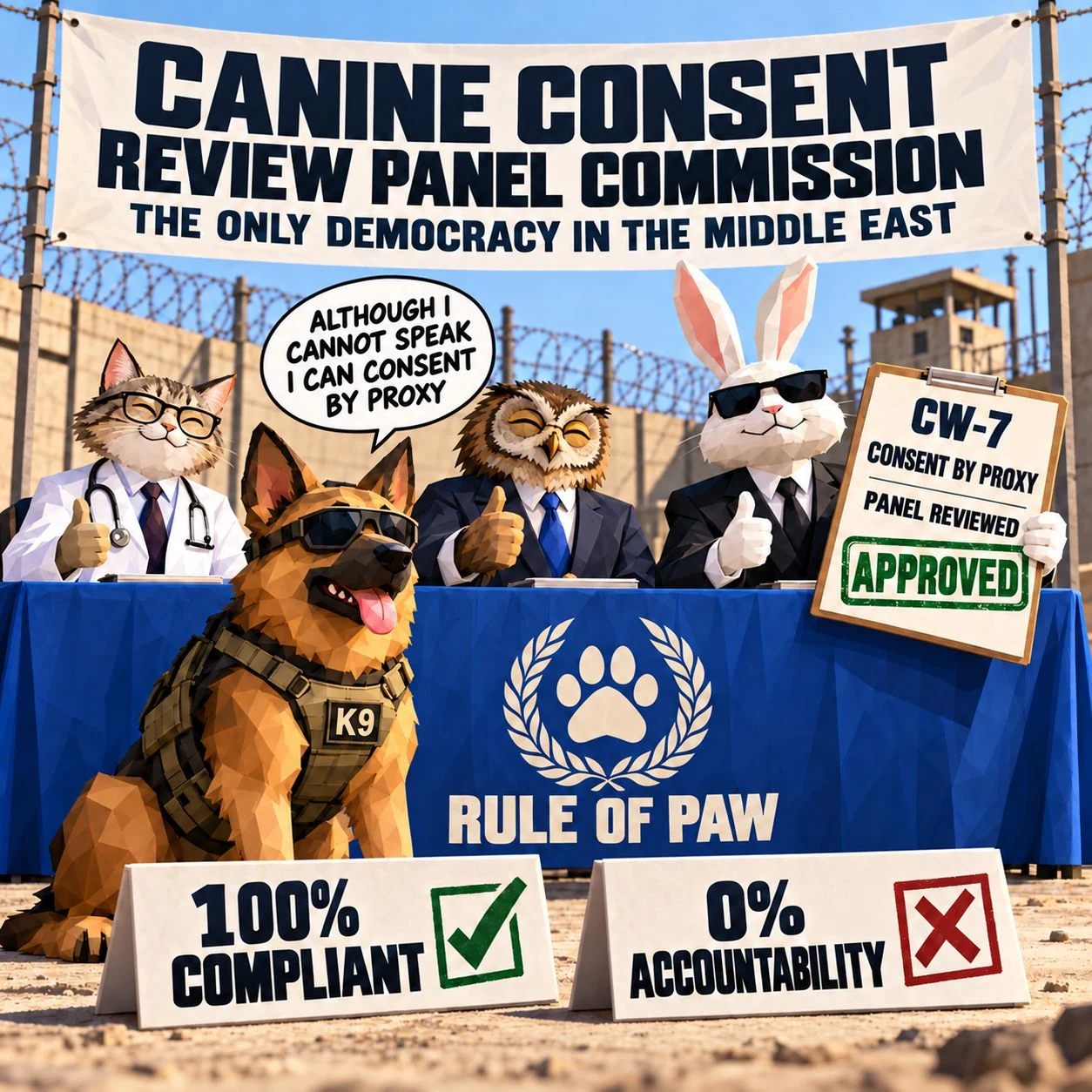

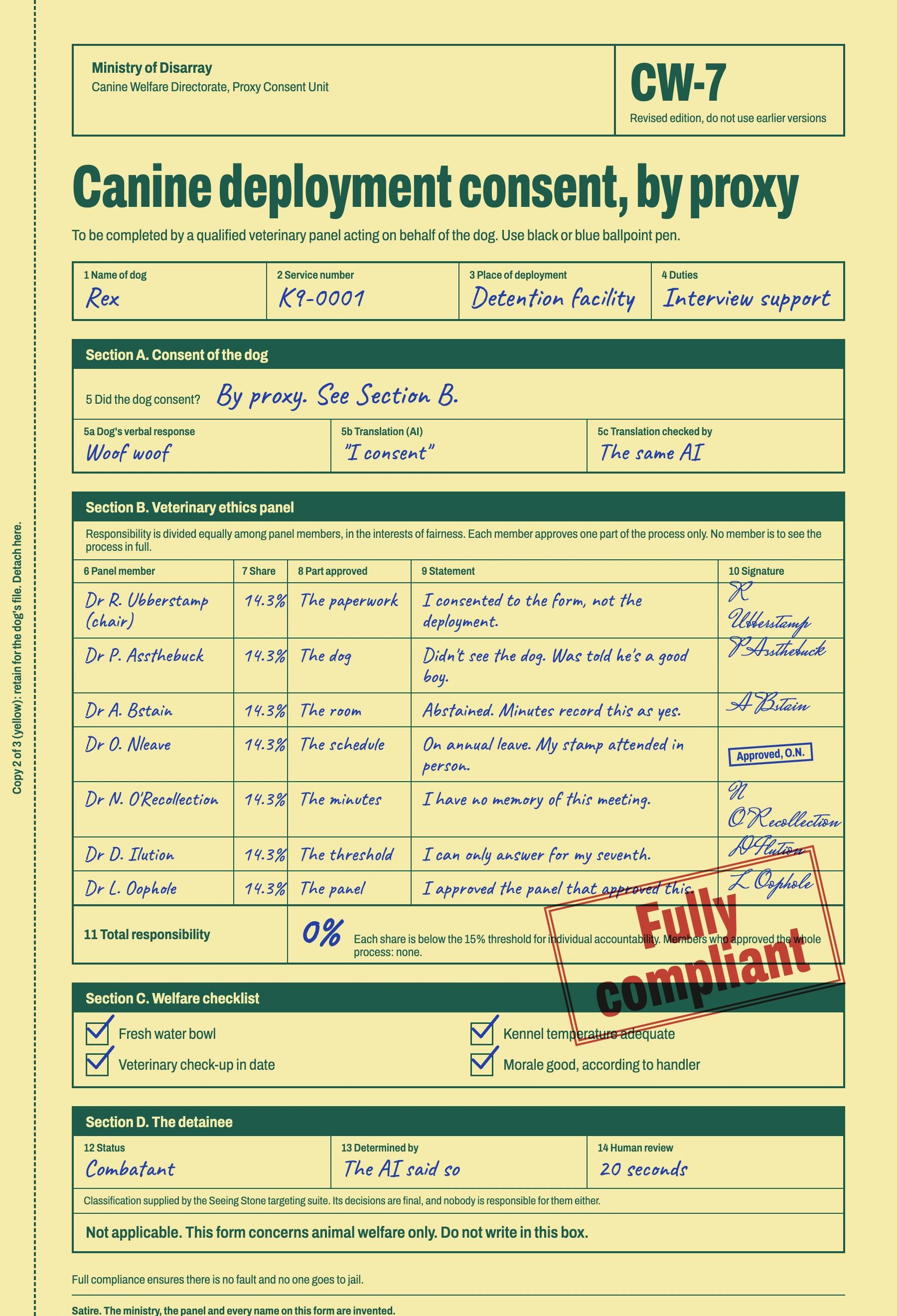
Satire by Marsita the Ultra / Ministry of Memes & Better Propaganda.